With how many years true mastery of it takes, winemaking is an art often passed down generations—from father to son, mother to daughter. When we think of it in this lens, we often imagine generations-old domaines with ancient vines taken over by a new generation in France, or perhaps some wunderkind in the Czech Republic revolutionizing orange wine after inheriting his parents’ esteemed estate.
That said, you don’t often hear of a natural winery that got its start in a family’s garage in the beachside suburbs of Sydney, but that is exactly where true-blue garagista winery Aristotelis Ke Anthoula began.

How did Aristotelis ke Anthoula start?
Working with knowledge passed down generations in the small villages of Greece they migrated from, Aristotelis and Anthoula Zafirakos started making wines for themselves, friends, and family in the early 1980s. They wanted to drink wine that tasted like home and not like the overly-polished work of a factory. It was something difficult to find at the time.
Using hand-picked grapes from the “box trade” at western Sydney markets, they began to quietly produce barrels of wine—never introducing any additives, never filtering, so that it was a pure wild-fermented grape juice that tasted vibrant and alive.
The demand from friends and family grew to the point that Aristotelis and Anthoula applied for a liquor license with their son Tony. Eventually, a sommelier who lived nearby came to visit after hearing about their truly authentic natural wines: after a taste through the wines, their wines were suddenly being served at one of Australia’s leading restaurants. Later, their wines would make it as back-to-back finalists of the Young Gun of Wine Awards and onto the wine lists of Michelin-starred restaurants across the world, from New York and Vienna to Tokyo and Shanghai.
These are New world wines made in a very old way, passed down through generations—and they’re now available in Metro Manila through the (Super)Natural wine store online!

An interview with winemakers Tony Zafirakos and Maddison Park-Neilson
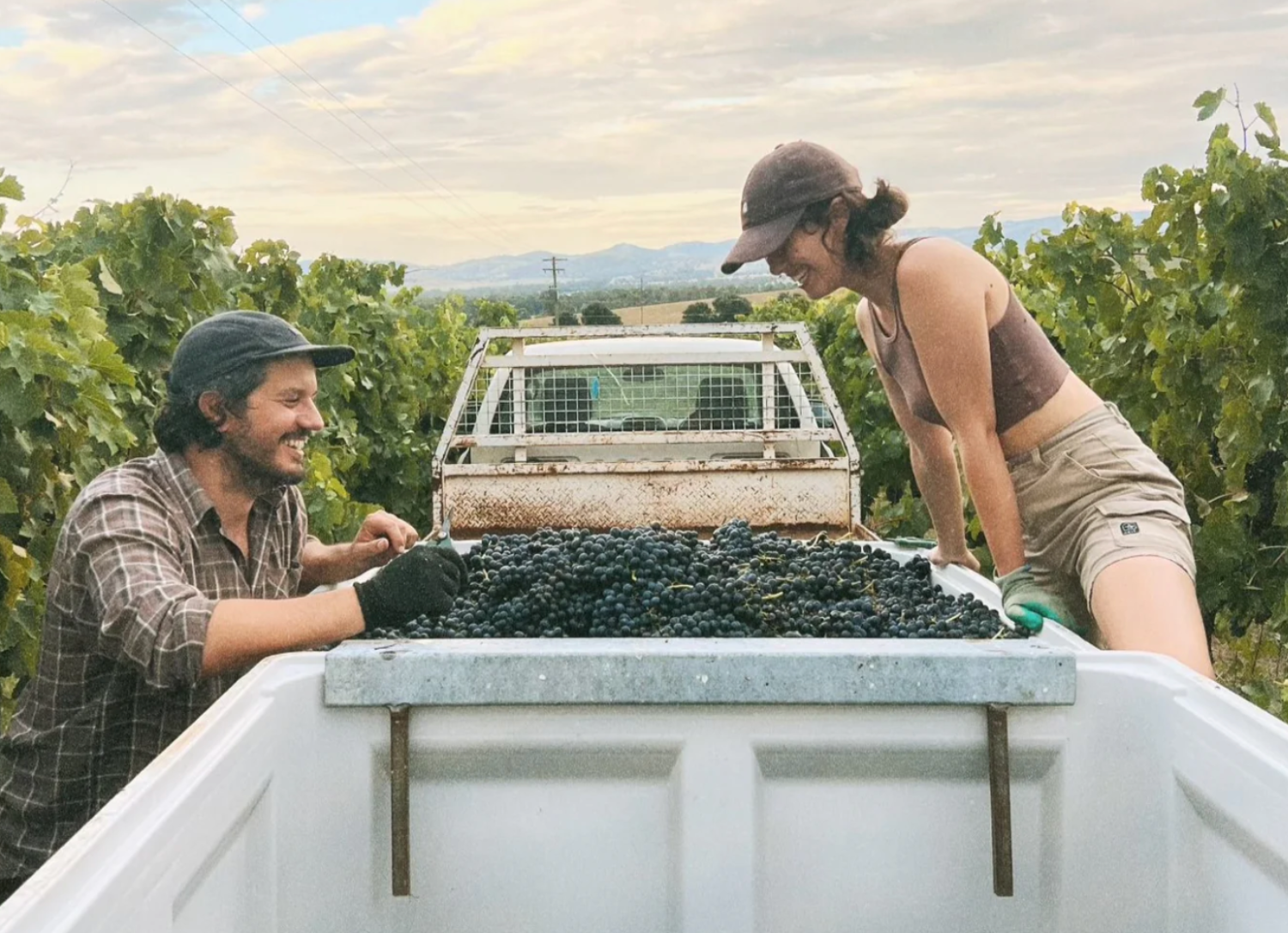
The Aristotelis ke Anthoula winery has long outgrown the family garage, and has since found a permanent home on the far south coast of New South Wales, in a small town called Merimbula smack dab in pristine oyster country. Aristotelis and Anthoula themselves have taken a back seat, but their son Tony Zafirakos (TZ) and his partner Maddison Park-Neilson (MPN) have taken the reins as winemakers with the same principles: making vibrant wines with high-quality organic fruit from across southern New South Wales, handled minimally with care and never with anything added or taken away.
Here, we interview Zafirakos and Park-Neilson about their winery’s story, as well as their old world meets new world winemaking and the beauty of New South Wales’ terroir:
The story of your winery began with your parents, but what about it attracted you?
TZ: Making wine was something that my family did each year, just like Italian families might process late season tomatoes into passata for the year. Some of my earliest memories are of stomping grapes with my family.
Between that and my parents always maintaining a thriving vegetable garden, I was always drawn to the idea of being close to nature, and from a young age believed that there was an honesty and a sense of nobility about it.
I never really thought about it as a possible career path, until I first came across what a friend called “natural wine,” and it tasted like my family’s wine. I’d never come across the term before, and the strangely coloured, sometimes cloudy wine that I had always made with my family suddenly had a context and it had a community.

How did you go about learning the ropes of winemaking more formally?
TZ: In the years that followed my discovery of natural wine, I travelled to Europe every Australian winter to take part in the harvest. Over the years, Maddie and I have between us worked in natural wineries in Italy (Ajola in Umbria, Gazzetta in Lazio, both run by former employees of famed Italian natural wineries, Le Coste and Cantina Giardino), Germany (2naturkinder, Franken), and Greece (Kontozissis, Karditsa), and visited many more.
We’ve learnt so much from my parents, but these experiences helped to shape our understanding of our own project at home and filled in any gaps in knowledge that we had, until we felt technically ready to focus on our own production. From that point, it became more about gaining a deeper understanding of the grapes and terroir we were working with.
After years of doing it, how would you describe your own approach to winemaking?
Our winemaking style is very much about taste and intuition. We don’t really have any golden rules but we prioritise good balance in our wines. We look to maximise flavour without sacrificing acidity and freshness—this means only using varieties well-suited to the regions they’re grown in.
Some zero-zero winemakers prefer stainless ageing for its cleanliness, but we will choose organic vessels wherever possible. Elevage will always be in either clay amphora or old French oak barrels. We find the wines develop much better and have a beautiful stability to them that eschews the need for added preservatives.
We always choose taste over numbers. A wine can have perfect numbers with regard to ripeness, but the priority has to always be about flavour intensity and balance, this is what we believe makes a better finished wine.

Would you say your methods today are inspired by those of your parents'?
MPN: We still use the destemmer Ari and Tony made together in the garage. It’s a stainless steel grate with a wooden frame we place over the top of fermenting tubs. It doubles as both a destemmer and a sorting table—something particularly important for avoiding off flavors in our extended skin maceration wines.
The press is a little bigger now but it is still a basket press, we love the slow and gentle oxidative process it gives our wines. While oxidation is the biggest risk in making wines without added sulphites, this early exposure is important for the final stability of the wine.
Overall, we have endeavoured to retain the old world village style of winemaking that Tony’s parents brought with them to Australia, and while we try to find efficiencies in our work flow and equipment, the first question we always ask ourselves is whether any change will fundamentally alter the character of what we are trying to stay true to.
Aristotelis and Anthoula still help out here and there during harvest and throughout the year, we think they’re still some of the fastest grape pickers in the vineyard but they’re deep in their well-deserved retirement now. Anthoula has always been incredible with providing much-needed harvest feasts—often with home-grown ingredients. There is nothing better than eating a comforting meal between all the hard work.
What do you think Aristotelis ke Anthoula does differently from other wineries?
Our wines have a strong sense of character. They are so intertwined with our family experience—very old world Greek winemaking in a new world environment. We make references to growing up in coastal Australia, like eating orange-mango ice blocks in summer with Sonnyboy, and we celebrate ancient culture with our version of Greek retsina using old vine Muscat of Alexandria grown here and pine resin from the north of Greece.

How do you think the terroir of New South Wales shapes your wines?
We are located on the southernmost part of the east coast of Australia, where there is a mountain range that runs just inland from us called the Great Dividing Range. It blocks much of the rain coming from the ocean leaving the inland areas much drier, making for good concentration of flavour and minimal fungal pressure.
We have some extremely ancient soils here in Australia—an even mix of decomposed granite and some more volcanic basalt and ironstone based soils. These, along with our cultural influences here in Merimbula of the ocean and the fresh oysters and seafood that are abundant, influence both the grapes we work with as well as the direction we take our wines in.
You guys work with a lot of Mediterranean varietals—what was your criteria for choosing them?
There is so much yet to be explored in Australia—where we should be growing vines, and which varieties to grow in each place. Historically, NSW has been dominated by Shiraz and Chardonnay due to market appeal, but fortunately that has started to shift in the last 20-odd years. We are now seeing what mature Mediterranean varieties can do, which is super exciting and we are so happy to be part of forging the way forward. Over the years we have experimented a lot and found the varieties we like to work with—those that have balance in the place they are grown, that can give us profound wines with freshness and minerality while expressing their site.

What do you think is the importance of wine being made organically and naturally today?
With heavy processes becoming so normalised, increasingly each day we consume more and more things of unknown origins, farmed in ways that are unsustainable, largely with impacts on our body and the environment that are either unknown or known to be detrimental.
We think a look at simple times, slow processes, and hand-grown food is important as things become more complicated around us. Just because we can manipulate and mass produce something, doesn’t always mean we should. And in the particular case of wine, it just so happens that the result is fuller-flavoured, more interesting, and more expressive. Wine is about enjoyment after all, so of course we should always try to maximise this!
What’s next for your winery?
We have some exciting developments coming up. We hope to be in our new winery space in mid 2026 which is due to begin construction soon, and we have partnered with the vineyard we work with in Gundagai to graft in some new Mediterranean varieties – this year Muscat of Alexandria, Vermentino and Xarello are going in, and soon after we will be planting the first-ever Assyrtiko vines—which I believe would also make them the first-ever Greek variety—in New South Wales. Given that Assyrtiko originates in the volcanic soils of Santorini, we cannot wait to see what the ancient volcanic soils of Gundagai express through this variety.
Where to buy Aristotelis ke Anthoula natural wines in Metro Manila
Aristotelis ke Anthoula offers New World wines made in a very old way, made pure and vibrant with high-quality organic wines across New South Wales, and you can now buy these proudly natural wines in Metro Manila at (Super)Natural. We offer the 2023 vintage of signature bottles like their Little Red, Pink, White-ish, Pash & Pop, Sparkling, and Riverland.
Buy Australian natural wine now at (Super)Natural. Same-day delivery available weekdays for Metro Manila addresses on orders placed before 2 PM.